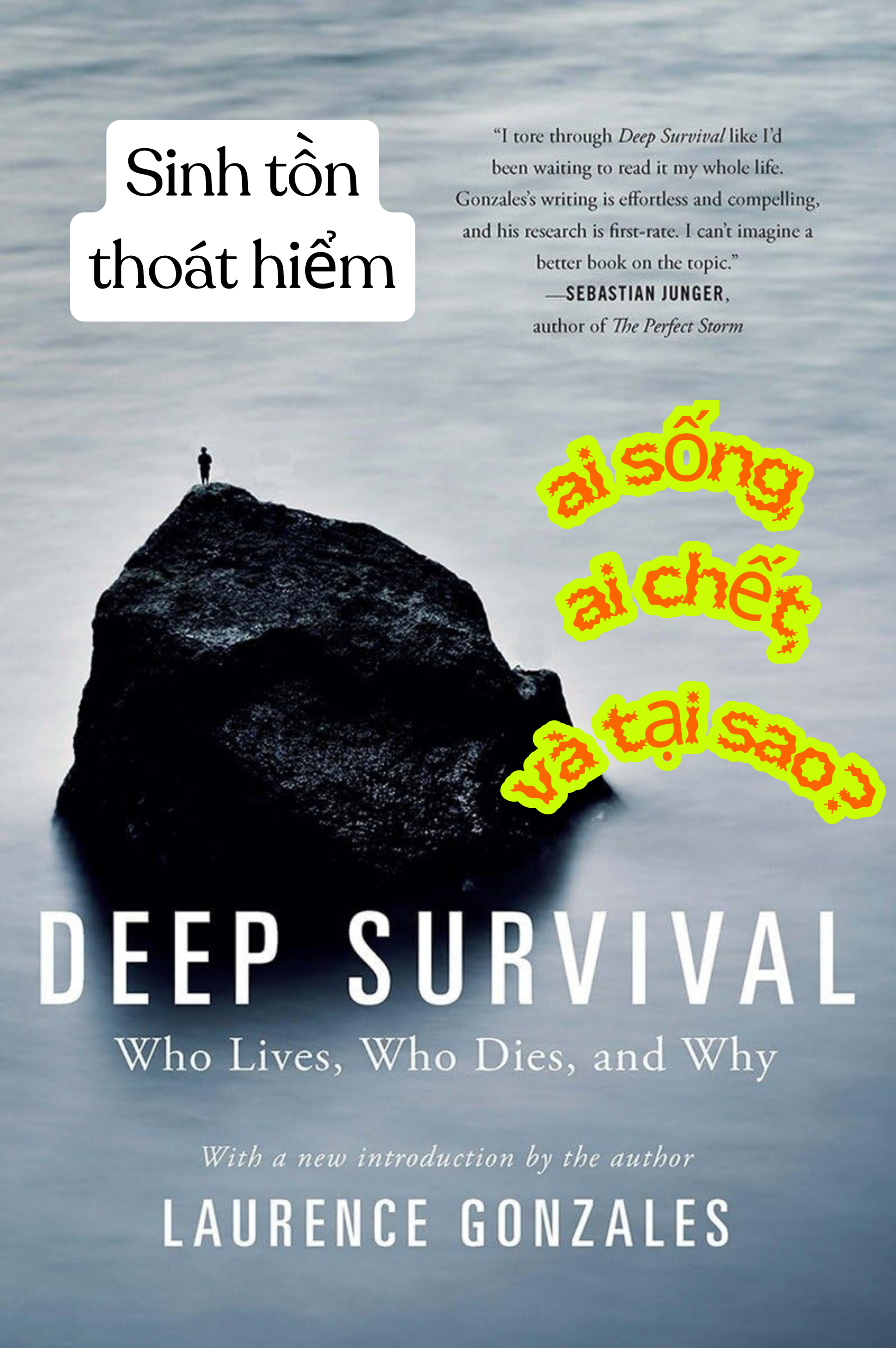
If you're looking for a survival guide on how to get lost, live in the jungle, or face a disaster, or skills like how to make fire, clean water, or food, this book is completely different. It tells the stories of survivors and those who didn't survive accidents while mountain climbing, skiing, or at sea, explaining why, what distinguishes the living from the dead in a disaster, and how the brain and human psychology work.
If you're looking for a survival guide on how to get lost, live in the jungle, or face a disaster, or skills like how to make fire, clean water, or food, this book is completely different. It tells the stories of survivors and those who didn't survive accidents while mountain climbing, skiing, or at sea, explaining why, what distinguishes the living from the dead in a disaster, and how the brain and human psychology work.
We may be well-prepared with equipment, training, and experience; however, it turns out that at the crucial moment, these things, while helpful, are not decisive and can even betray us.
What we truly need to know for survival is understanding the system we call emotions – how they work powerfully and rapidly to drive behavior. When we are stressed, cortisol is released in large quantities into the bloodstream. It invades the hippocampus and interferes with its function. As a result, when stressed, most of us are almost incapable of doing anything except the simplest tasks. We can't remember the most basic things. Furthermore, stress (or any strong emotion) erodes cognitive ability. Cortisol and other hormones released during stress interfere with the activity of the prefrontal cortex. This is where cognitive processing and decision-making take place. We see less, hear less, miss more environmental cues, and make mistakes. In extreme stress, the visual field actually narrows. Stress causes most people to focus narrowly on what they perceive as most important, and that may not actually be the case. To avoid making mistakes, we must help balance our emotions and reason.
So, is there a way to help us balance our emotions and reason?
Here's a tip for you: observe Mr. Ta in "Red Rain"; he did this very well :)
Survivors of disasters aren't fearless; they do experience fear, but they don't let it overwhelm them. They transform that fear into strength.
One of the many perplexing mysteries is predicting who will survive and who won't. According to one researcher, the group with the highest survival rate is children aged 6 and under, while the group with the lowest survival rate is children aged 7-12. Science hasn't yet explained precisely why, but the author offers some fairly logical explanations.
Other psychologists studying survivors of shipwrecks, plane crashes, natural disasters, and prison camps have concluded that each person's attitude determines who survives.
Some survivors discover a deep spiritual connection to the world. They often have a talisman that connects them to the world, and they see the world differently. They trust their intuition more.
Furthermore, it is the struggle itself that keeps people alive. What seems paradoxical is simply the act of living: Never stop struggling. When the struggle ends, we die.
For me, this is a very good book. The author analyzes and presents logical psychological research models alongside interviews with survivors. There are truly many lessons we can learn from this book, especially preparing us psychologically by understanding what will happen when an incident or a disaster occurs.
Perhaps the biggest shortcoming of this book is that we couldn't interview those who died, so we can't fully verify the author's arguments, nor can we get a complete picture of whether the actions of the survivors were entirely justified or simply luckier than those who perished. This isn't meant to negate their extraordinary efforts, but rather to complement and complete the picture. This book isn't about telling people what to do, but about helping us know what to do when that time comes – and that time always comes, in some form, for all of us. This book isn't just for mountaineers, fighter pilots, or kayakers who face death in their own way; it's for all of us who want to overcome life's challenges. Survival situations can occur in the wilderness, but also in war, disease, business failure, a burning building, and countless other forms.
The author argues that everyone should learn basic survival skills and the mindset of a survivor because they are incredibly useful when the comforts of civilization (or even financial or emotional support) that we take for granted can disappear for any number of reasons. And I agree!
Additional information:
Deep Survival: Who Lives, Who Dies, and Why is Laurence Gonzales' most highly-rated book. This book currently has no published translation in Vietnam. Another book by him that has been translated and published in Vietnam is titled "Every Day of Survival."